What Patio Shade Fabric Is Actually Made Of
October 12, 2026 · 6 min read
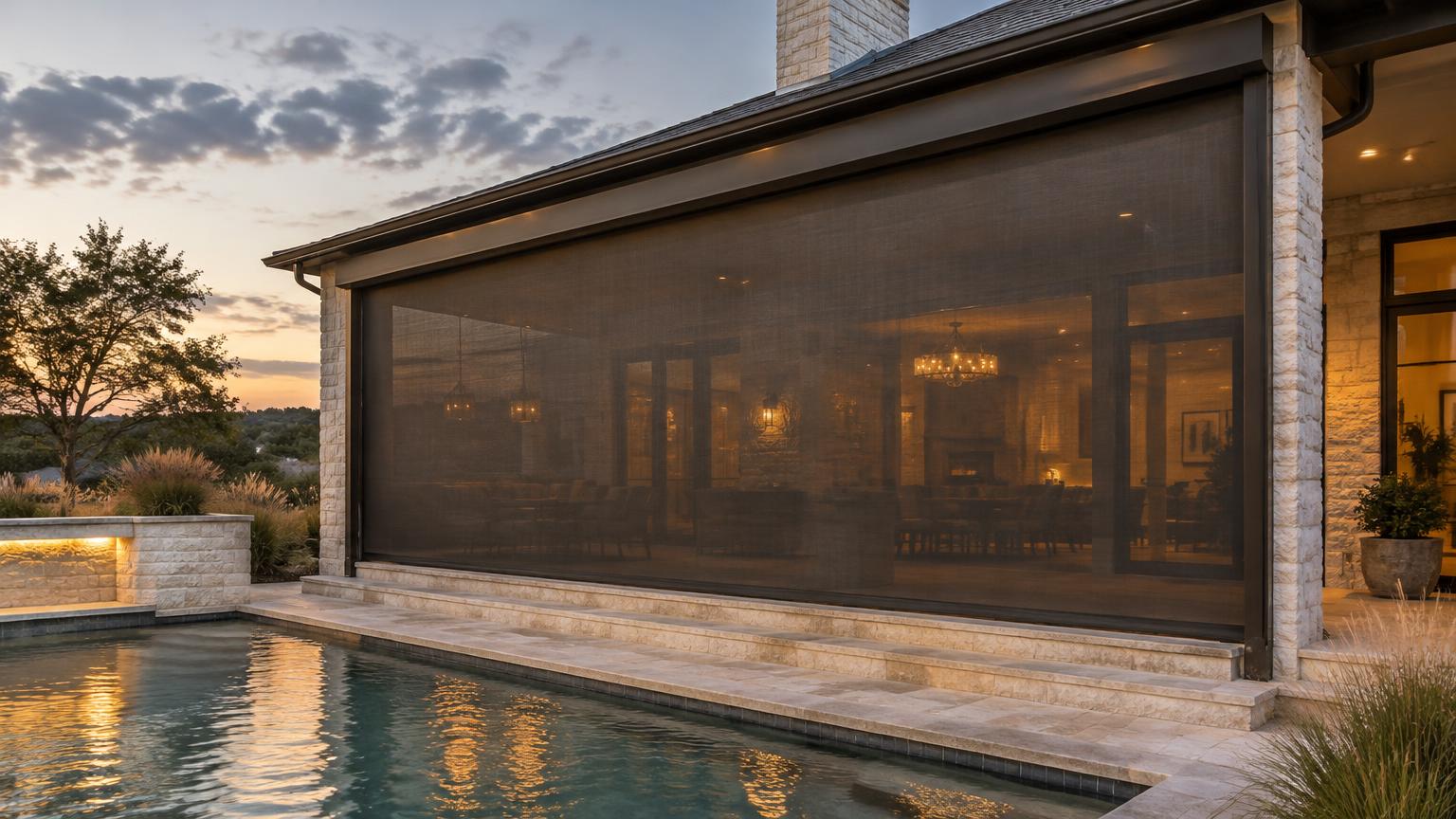
Most homeowners never see a spec sheet for their patio shades — and that's fair, it's not exactly light reading. But the fabric is the part of the system that does all the work: it's what actually stops the heat, holds the tension in a 90 mph gust, and still looks like the day it was installed five years later. Here's what the screens we install are genuinely made of, and why the construction matters more than the color swatch.
The short answer: polyester yarn, PVC coating
The solar screen fabric on your patio is a woven mesh of polyester yarn that has been coated and bonded with PVC. By weight it works out to roughly 26% polyester and 74% PVC, and that ratio holds across every openness we carry. The two materials are doing different jobs. The polyester yarn is the skeleton — it carries the tension, resists stretching, and gives the fabric its tensile strength. The PVC coating is the skin: it carries the pigment, sheds water, blocks UV, and keeps the weave dimensionally stable so the fabric doesn't sag or creep over time.
That's why this material feels different from an indoor roller shade. It isn't cloth that's been treated to resist weather; it's a coated mesh built to live outside permanently. Run your hand across it and you can feel the individual yarns under a smooth, slightly waxy surface — that surface is the PVC doing its job.
The protection is built into the yarn, not painted on the surface
This is the single biggest difference between a fabric that lasts a decade and one that chalks and fades by year three. Cheap outdoor screens rely on a topical treatment sitting on the surface of the weave. Sun and rain work that layer away, and the fabric starts breaking down from the outside in.
The UVtex SC-UV2 fabric we install takes the opposite approach. Ultraviolet absorbers are compounded into the yarn itself, and the yarn uses a patented anti-aging reinforcement formula. Those absorbers capture incoming UV photons and convert them to a tiny amount of heat instead of letting them degrade the polymer. In plain terms: the protection is in every strand, so there's no coating to wear off. That's what the manufacturer means by photo-aging resistance, and it's the reason the fabric can carry a ten-year warranty instead of a two- or three-year one.
Openness is a physical property, not a filter setting
When you choose 1%, 3%, or 5% openness, you're choosing how much of the weave is open space — and that changes what the fabric physically is. A tighter weave has more yarn and more PVC per square meter, so it's heavier and thicker. The 5% fabric we install most often weighs about 518 g/m² (roughly 15 oz per square yard) at around 0.75 mm thick. The blackout option, with no open space at all, climbs to about 753 g/m² and nearly a millimeter thick.
That extra mass buys real strength. Across the range, the fabric holds between roughly 2,200 and 3,100 newtons of pull per 5-centimeter strip before breaking — over 500 pounds of force across a two-inch-wide band — and resists tearing in every direction. This is what lets the edges stay locked in the zip track and hold tension in a 90 mph gust instead of billowing out of the channels.
How the fabric is tested before it ever reaches a Texas roof
Before a fabric earns a place on a custom home, it goes through accelerated weathering: AATCC TM186 exposure, which blasts coated textile samples with fluorescent UV lamps, high heat, and condensation for more than 1,500 hours, then grades the damage. Our fabric rates 4 to 5 on that scale, the good end of the range. Color fastness is measured separately under ISO 105-B02 and ISO 105-B04, where it scores 7 or better — meaning the pigment holds rather than bleeding or fading.
The samples are also cycled through the things a Dallas backyard actually throws at them: continuous salt-and-alkali corrosion, sea-breeze exposure, freeze-and-thaw down to about -22°F and heat up to roughly 158°F, chemical corrosion, and repeated wind-driven tearing. Mold and mildew resistance is tested to ASTM G21, and flame performance to NFPA 701. None of this is theoretical — it's the reason a screen on a west-facing Frisco patio behaves the same in August as it did the first week after install.
The certifications worth caring about
Because this material hangs over the space where your kids, your dog, and your dinner guests spend time, the chemistry matters. Our fabric is certified to REACH and RoHS (restrictions on hazardous substances), GREENGUARD (low chemical emissions), OEKO-TEX Standard 100 (tested for harmful substances in textiles), and California Proposition 65 for phthalate content. It's also tested antibacterial to ASTM E2180.
If you're building to a green standard — LEED, a builder's own wellness program, or just a house where you don't want off-gassing plastic near the windows — these are the lines to ask any shade company about. Not every outdoor fabric on the market clears all of them.
What it means on your patio
The manufacturer backs this fabric with a 10-year limited warranty covering defects in workmanship and materials, noticeable color mismatch, and excessive fading under normal sun, moisture, and atmospheric exposure. The performance curve is published: more than 95% color retention through the first five years and more than 85% strength retention through year ten. In practice, the fabric outlasts most of the finishes around it.
Fabric alone doesn't make a patio shade, though — it's the fabric locked into a sealed aluminum cassette and zip guide track that makes the system. Together they're endurance-tested past 40,000 open/close cycles (about 60 years of twice-a-day use) and hold up to repeated 90 kg impacts without pulling from the track. That combination is what we bring to your home at the free consultation: real samples, held against your actual view, at the time of day your patio gets the worst of the sun.
Frequently asked
- What is patio shade fabric made of?
- Our outdoor solar screen fabric is a woven polyester yarn that has been coated and bonded with PVC — by weight roughly 26% polyester and 74% PVC. The polyester carries the tension and strength; the PVC coating carries the color, sheds water, blocks UV, and keeps the weave from stretching out of shape.
- Is solar screen fabric plastic?
- Mostly, yes — the coating is PVC, which is what makes the fabric waterproof, flexible, and dimensionally stable. Underneath that coating is a high-strength polyester mesh doing the structural work. It's a coated textile engineered for permanent outdoor use, not a vinyl sheet.
- Will patio shade fabric fade in the Texas sun?
- Slowly, and far less than surface-treated screens. The UV absorbers are compounded into the yarn rather than coated on top, so there's nothing to wear off. The fabric passes 1,500+ hours of accelerated weathering (AATCC TM186) and rates above 95% color retention for the first five years, backed by a 10-year limited fabric warranty.
- Is the fabric safe around children and pets?
- It's certified to REACH, RoHS, GREENGUARD, OEKO-TEX Standard 100, and California Proposition 65 for phthalate content, and it's tested antibacterial (ASTM E2180) and mold-resistant (ASTM G21). It's also rated for flame performance to NFPA 701.
- How do I clean outdoor solar screen fabric?
- Mild dish soap and water with a soft brush or cloth, then rinse — the PVC surface doesn't absorb dirt the way cloth does. Skip abrasive scrubbers, pressure washers, and solvent-based cleaners, which can dull the coating over time.
- Does a heavier fabric mean better performance?
- It means more yarn and more PVC per square meter, which brings more strength and a slightly lower light and heat pass-through. Our 5% fabric weighs about 518 g/m² and the blackout about 753 g/m². The right weight follows the openness you want, not the other way around.
Ready to talk through your project?
Free in-home consultation across the DFW metroplex — no pressure, no sales pitch.
Call (817) 207-7959If I don't answer, leave a message — I'll call you back.